Does navigation or robotics help with joint replacement surgery?
This is a common question from patients that are preparing for an upcoming joint replacement. To answer this, let’s talk about knee, hip and shoulder replacements separately.
The shoulder joint is often compared to a golf ball sitting on top of a golf tee (big ball on a small socket). The socket (glenoid) tapers into a very thin bone, and the view of the socket that we get during a shoulder replacement does not allow us to see the bony anatomy past the joint surface. Because of this, my preference is to use live intra-operative navigation to confirm implant positioning. See the link below for a demonstration or visit the page on shoulder replacements
Shoulder Replacement video demonstrating Live Intra-operative Computer Assisted Navigation
On the CT images, you can see how precise we need to be while implanting the components in the glenoid (socket). There is also considerable variability in glenoid/scapula anatomy with a limited view of only the face of the glenoid. Placing the baseplate in the right position and then using the navigation tools to place the screws at the correct angle to get long screws and good purchase into the bone is what allows the implants to last.
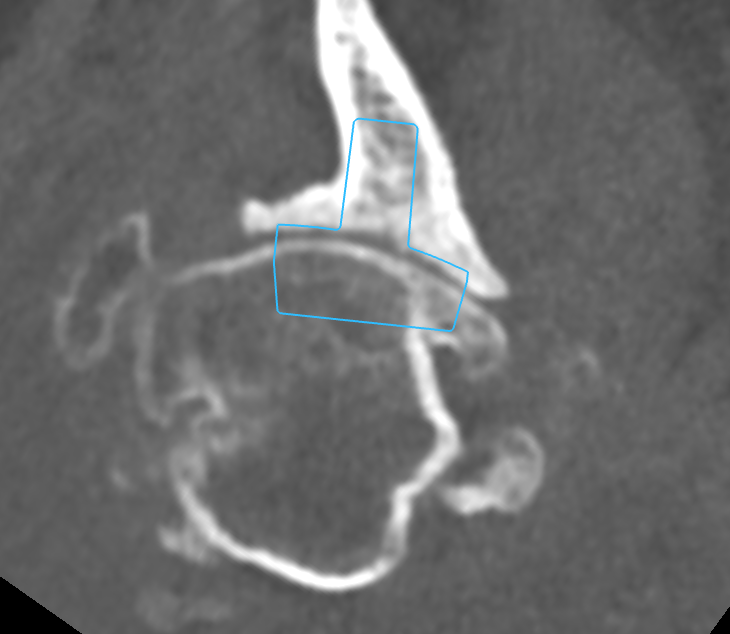
Preoperative planning, sizing & positioning baseplate for shoulder replacement
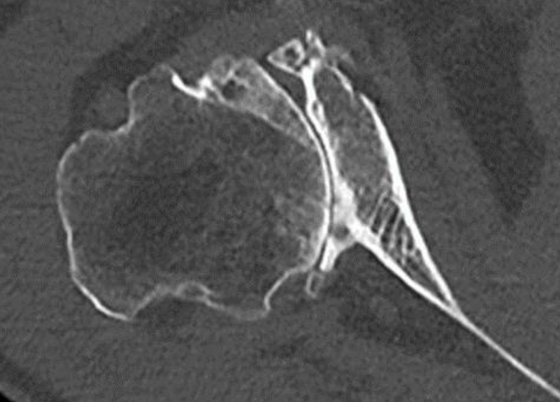
CT scan (Axial View) of severe glenoid (socket) wear
In my view, live intraoperative navigation is essential for accurately positioning shoulder replacement implants.
Robotics or Navigation for Hip Replacement?
The direct anterior approach for total hip arthroplasty has become a popular approach for doing hip replacements in recent years. This is largely because it allows surgeons to access the hip in between muscle groups without the need to work through muscles and because intra-operative fluoroscopy can be utilized to take images (like x-rays) and visualize the accuracy of implant placement during the surgical procedure. Adjustments in position or size can be made intra-operatively by analyzing these images. Therefore, I see little benefit of using robotics or navigation systems for these procedures.
Robotics or Navigation for Knee Replacement?
Of all three of these joint replacement procedures, a knee replacement offers the surgeons the best view of the bony anatomy. Bony landmarks, like the intra-medullary canal of the femur or the long axis of the tibia, offer excellent reference points to be utilized for these procedures. Temporary (trial) implants are positioned during the procedure to allow surgeons to assess range of motion and knee stability with great visibility to ensure that the final implants will be accurately sized and positioned, while allowing great range of motion.
When my patients ask about robotics or navigation systems for total knees, I give them an analogy using a navigation system such as google maps or Waze while driving. Most of us have used some app while we are driving somewhere unfamiliar to help us arrive at our destination. But, few of us need that same tool to help us get home from the grocery store that we frequently use because we have done it a thousand times and are familiar with how to do it.
Multiple well performed studies have also found no significant benefit with the use of robotics or navigation in patient reported outcomes during routine knee replacement surgery. In some select patients with severe bone loss and knee deformity, these tools may be beneficial. However, for a routine knee replacement in most patients, they offer little benefit.
